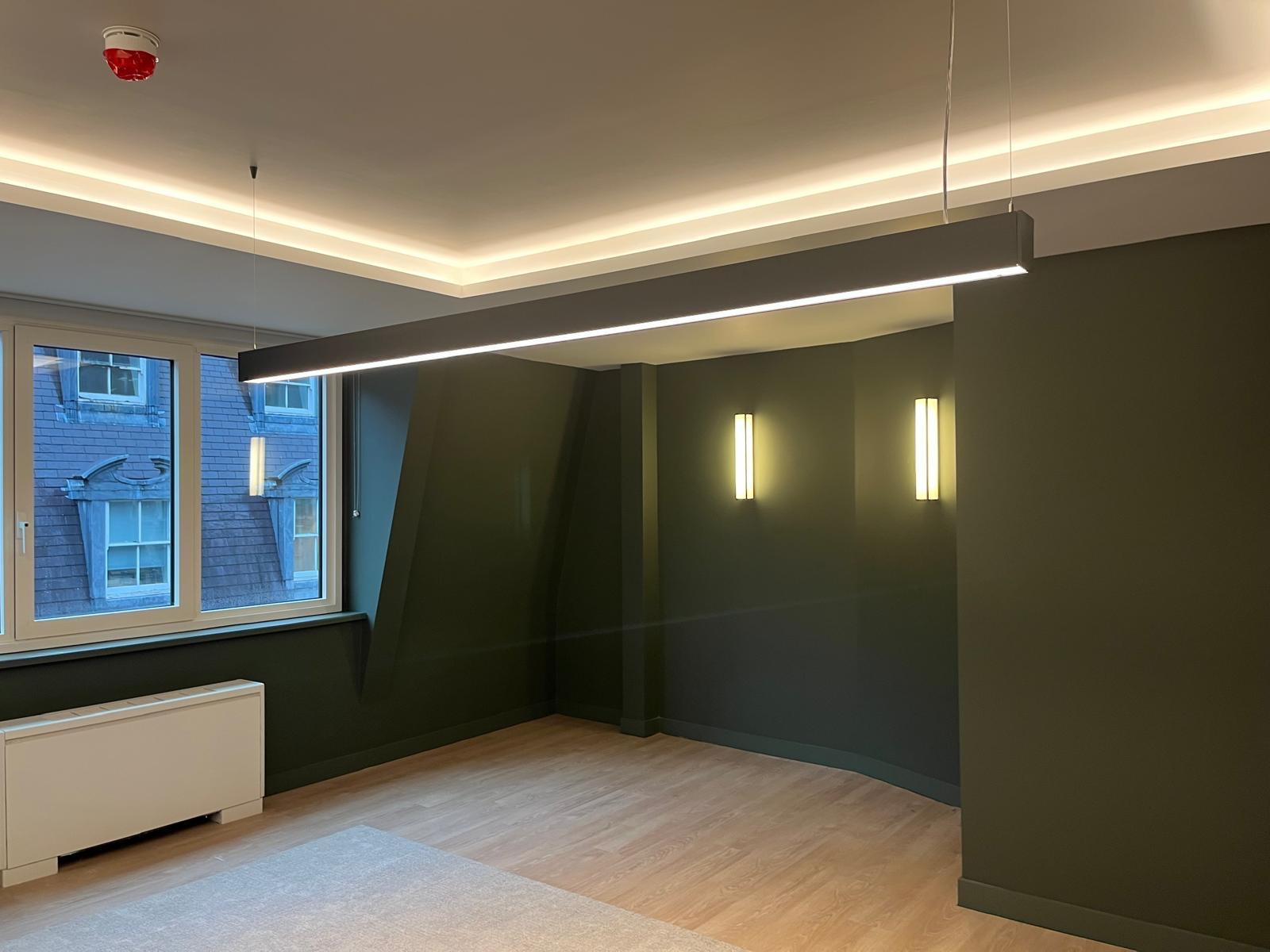
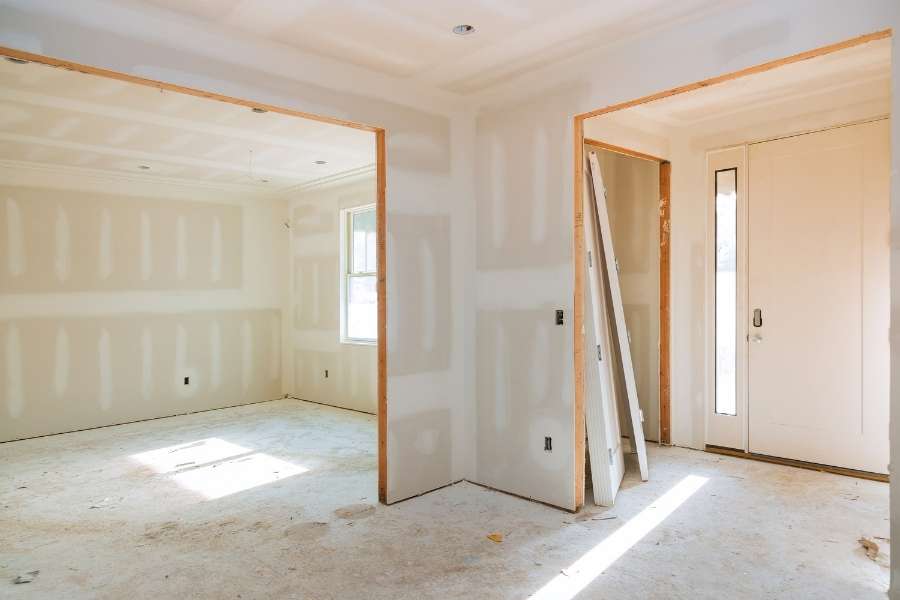
"High-precision" appears on a lot of contractor websites, ours included. On its own it means nothing. What it should mean is specific and measurable: a stated finish level, framing held within tolerance, and a jointing sequence that isn't rushed.
Here's what's behind the phrase, and how to tell whether you're getting it.
Finish levels
Plasterboard finishing is graded, and the grade is where nearly all the cost and quality variation sits. UK commercial specs commonly use Levels 0 to 5; Europe has its own four-level Q1 to Q4 system developed by Eurogypsum and the European federation of dry lining contractors.

Level | What it involves | Where it belongs |
|---|---|---|
0 | Board fixed, joints open | Tenant fit-out only — open joints compromise fire performance |
1 | Tape bedded at joints and angles; tool marks acceptable | Service voids, above suspended ceilings, plant rooms |
2 | Tape plus a thin coat over joints and fasteners | Behind tiling, low-visibility areas |
3 | Two coats over joints and fasteners | Heavy textured coatings and wall coverings — not flat paint |
4 | Three-coat system, finished free of tool marks and ridges | The standard for normal painted decoration |
5 | Level 4 plus compound skimmed across the whole board face | Critical or raking lighting |
One detail that trips up a lot of jobs: a Level 4 that's been skimmed is not a Level 5. Different specification, different labour.
Lighting decides the level, not budget
The most common finishing complaint isn't bad workmanship — it's raking light. When light hits a wall at a shallow angle (a downlight tight to a wall, an LED strip in a shadow gap, low winter sun through full-height glazing), it throws a shadow off any variation in the surface. A joint that's invisible under diffuse ceiling light becomes a visible ridge.
Two things follow. Decide your lighting before you specify your finish — if the lighting design lands after the walls are done, you can end up reworking a whole surface. And be realistic: Eurogypsum's own guidance is candid that even at the highest classification, some marking under shallow light can't be entirely eliminated. A higher level buys you considerably less of it, not perfection.
If a wall will be washed with light and Level 5 is out of budget, use textured coatings or wall coverings. Specifying Level 4 and hoping is not a plan.
Most of the outcome is decided before any tape goes on
Framing tolerance. No amount of compound corrects a stud line that's out. Checking it is a five-minute job that gets skipped constantly.
Board layout. Cut edges want to land over a support, and ceiling boards should be staggered so joints don't run continuously — one of the main ways to reduce later cracking.
Screw depth. Too deep breaks the paper face and loses grip; not deep enough and it telegraphs through the finish.
Board type. Moisture-resistant to wet areas, correct build-up where a fire rating applies. Substituting because it was on the van is a defect, not a shortcut.
Sealing. Air paths at the perimeter and service penetrations need sealing, or you lose the acoustic and thermal performance you specified.
Conditions matter more than people expect
Sector guidance is explicit that taping and jointing should only happen in dry conditions, above 5°C, with the building watertight. This is why unheated winter refurbs go wrong: compound that dries too slowly doesn't bond, and the cracking shows up months later — after the decorator has gone and nobody can agree whose problem it is.
The three-coat sequence also needs drying time between coats. A programme that compresses boarding, three coats, sanding and painting into a few days is borrowing time it will have to repay.
Checking it yourself
Run a straight edge across a finished joint — you're feeling for a smooth transition, not a ridge or a hollow. Then hold a torch flat against the wall and shine it along the surface; that replicates raking light and shows you everything. Check internal angles for consistency and external corners for properly filled beading.
What to put in your spec
Finish level, by number, room by room if it varies
Board type and thickness per area, including moisture-resistant and fire-rated locations
The lighting conditions the finish must perform under
Who's responsible for heating, weatherproofing and drying time in the programme
Get those four written down and quotes become comparable, which is most of the battle. Our guide to choosing a drywall contractor in London covers the commercial side of the same problem.
Need a finish that holds up under the lighting?
DAI City Drywall has installed dry lining, drywall and tape and jointing systems across London, Kent and Essex for over 20 years, from single-room refurbishments to full developer fit-outs. We quote to a stated finish level and we'll tell you honestly which one your lighting design needs.